

Please Choose Your Language
Views: 0 Author: Site Editor Publish Time: 2026-06-16 Origin: Site


In hydraulic applications like excavators, agricultural lifts, and mobile cranes, catastrophic load drops pose severe dangers. A hose burst valve acts as a critical fail-safe against these sudden velocity spikes. People often call this component a velocity fuse. It instantly halts free-falling loads during sudden line ruptures. Selecting the wrong component either severely compromises system safety or causes immense operational frustration. An incorrectly specified component might fail to lock during an actual emergency. Conversely, a poorly tuned component often triggers nuisance tripping during everyday use. This buying guide gives you an objective, spec-driven resource. We want engineers and procurement teams to evaluate their options confidently. We will help you select the right hose burst valve in hydraulic systems based on flow parameters, mounting types, and compliance standards. Read on to master precision sizing and avoid costly field failures.
Sizing is paramount: A hose burst valve must be tuned to trigger at a flow rate typically 30% to 50% higher than the maximum normal operating flow to prevent accidental locking.
Placement matters: To be effective, the valve must be installed as close to the actuator/cylinder port as physically possible, not further down the hose line.
Form factors vary by application: The choice between inline, cartridge, and flanged designs dictates ease of retrofit, space requirements, and pressure ratings.
Compliance is non-negotiable: Safety-critical applications require valves that meet recognized machinery directives (e.g., ISO 8643 for earth-moving machinery).
Catastrophic failure mitigation forms the absolute foundation of hydraulic safety. Let us review the core physics involved. Pressurized fluid essentially holds a heavy load in place. If a hydraulic line suddenly ruptures, you instantly lose crucial backpressure. This sudden pressure loss causes the load to free-fall immediately. The safety mechanism detects this massive velocity spike immediately. It snaps shut and isolates the remaining fluid. The load stops falling. This rapid action protects human operators and prevents severe machinery damage.
Regulatory and compliance drivers make this component mandatory. You simply cannot ignore occupational safety rules. Mobile elevating work platforms (MEWPs) and heavy lifting equipment must meet strict legal guidelines. Proper implementation is a hard legal requirement for obtaining CE marking in Europe. Regulators worldwide demand strict adherence to standardized machinery directives. For example, ISO 8643 explicitly dictates how earth-moving machinery must handle sudden line failures.
We must also understand the heavy cost of poor selection. Incorrect specification introduces two distinct operational risks. You must balance the physical tuning carefully.
First, under-sizing your equipment causes continuous nuisance tripping. Hydraulic fluid becomes cold and highly viscous in winter. Thick oil creates higher pressure differentials across internal boundaries. These everyday pressure spikes trick the system entirely. The mechanism falsely assumes a hose has ruptured. It locks up repeatedly during normal tasks. This false alarm frustrates operators deeply. It ruins daily productivity and forces unnecessary maintenance checks.
Second, over-sizing nullifies your entire safety investment. A gap setting tuned too wide creates dangerous blind spots. The system fails to recognize a partial burst. It also ignores slow ruptures entirely. The fluid leaks out rapidly. The load crashes down anyway. The component basically becomes useless. You essentially paid for a safety feature but receive zero protection.
Engineers must select the correct form factor for their specific machinery. The physical design dictates installation ease, space usage, and maximum pressure limits. You will generally encounter three primary configurations. Each configuration serves a specific engineering niche.
Inline designs work best for quick retrofitting tasks. They perform exceptionally well on agricultural equipment. You should choose inline models when cylinder-port integration proves physically difficult. They sit directly inside the piping infrastructure. You thread them straight into the existing line. However, you face notable trade-offs here. You must install robust, rigid piping between the safety block and the cylinder. Flexible hoses in this intermediate zone ruin the safety integrity. A burst in that flexible section bypasses the protection entirely.
Cartridge-style designs offer massive benefits for Original Equipment Manufacturers (OEMs). They fit perfectly into custom manifold blocks. They also save critical space inside constrained mobile hydraulics. Cartridge options integrate directly into the cylinder head. They sit hidden inside the metal housing. Yet, they require highly specific cavity machining during manufacturing. They also prove harder to replace in the field. Maintenance teams usually need specialized extraction tooling to service them.
Flanged or direct-mount designs dominate heavy-duty industrial environments. They handle extreme mobile applications like excavators. They require direct hard-mounting straight onto the cylinder port. They provide the most secure fail-safe connection available today. The thick steel flange absorbs massive physical shocks. The main trade-off involves a noticeably higher initial component cost. You must also ensure the flange block matches your specific cylinder bolt pattern perfectly.
Form Factor | Best Application Use Case | Primary Advantage | Main Trade-off / Limitation |
|---|---|---|---|
Inline | Agricultural lifts, quick retrofits | Extremely easy to install in existing circuits | Requires rigid piping to the cylinder port |
Cartridge | OEM designs, custom manifolds | Saves space, highly integrated | Requires exact cavity machining, hard to extract |
Flanged | Excavators, heavy mobile machinery | Maximum structural security and shock resistance | Higher initial cost, requires matching bolt patterns |
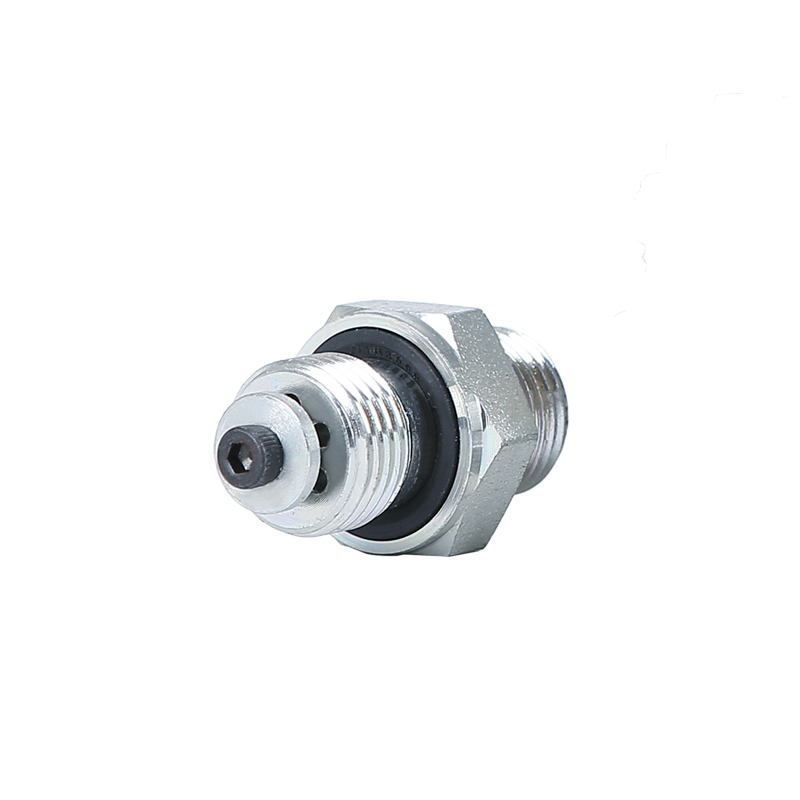
Specification requires rigorous mathematical calculation. You cannot guess the required trigger point. Proper functionality relies strictly on accurate fluid dynamics data.
Flow rate and the gap setting demand your careful attention. The adjustable gap determines the exact reaction flow. Manufacturers typically label this adjustment Dimension 'S' or Dimension 'F'. The formula for setting the trigger point relies on your baseline metrics. We recommend a strict rule of thumb. You should target a closing flow 1.5 times the maximum intended system flow. This exact 50% buffer prevents accidental lock-ups during rapid directional shifts.
Simple Flow Reaction Calculation Chart | ||
Normal Max Flow (L/min) | Multiplier Buffer | Target Reaction Flow Setting (L/min) |
|---|---|---|
20 L/min | x 1.5 | 30 L/min |
50 L/min | x 1.5 | 75 L/min |
100 L/min | x 1.5 | 150 L/min |
Pressure ratings represent another non-negotiable metric. You must match the maximum working pressure precisely. A standard system might operate smoothly at 250 Bar. However, you must account for sudden shock loads. Heavy earth-moving machinery often generates peak pressure spikes up to 350 or 400 Bar. The body material must withstand these transient forces without warping or cracking.
Port and thread sizes require meticulous matching. Standard availability usually ranges from 1/4" to 1" BSP or NPT. Matching the exact thread type prevents hazardous fluid leaks. It also eliminates unwanted pressure drops across the connection. Mismatched threads strip easily under high operational loads. You must follow a precise sizing checklist:
Verify the exact inner diameter of your existing hydraulic lines.
Identify the thread standard (BSP, NPT, SAE, or Metric).
Measure the pitch distance between threads to confirm compatibility.
Select the appropriate sealing method (O-ring, bonded seal, or taper thread).
Engineers must also decide between fixed versus adjustable orifices. Factory-preset units offer tamper-proof reliability. You buy them for high-risk fleet vehicles where operators might meddle. The factory permanently locks the setting. Field-adjustable units offer superior flexibility for prototype testing. They adapt easily to variable loads. However, they introduce a much higher risk of operator error. Untrained technicians might accidentally adjust the gap too wide.
Field environments rarely match clean laboratory conditions. Environmental factors heavily influence reaction times. You must anticipate real-world friction and temperature changes.
Cold weather dramatically alters fluid viscosity. Cold hydraulic oil resists flowing freely through tight gaps. This resistance artificially increases the pressure differential across the internal poppet. The mechanism misinterprets this drag as a massive velocity spike. It mimics a catastrophic hose burst completely. You will experience a false lock almost immediately. We recommend basic mitigation strategies for winter operation. Operators should run warm-up cycles before lifting heavy loads. Engineers might also specify slightly larger gap settings for arctic environments.
Trapped pressure release creates major headaches for maintenance crews. You must reset a locked system safely. A trapped load holds the poppet firmly closed. You cannot simply force the mechanism open mechanically. Doing so damages the internal seals severely. A trapped load requires a specific resetting procedure. Usually, this means bleeding the circuit carefully. Alternatively, you can apply pump pressure to the blocked line. This counter-pressure equalizes the internal forces. The spring then pushes the poppet back open safely.
Orientation and gravity subtly impact daily performance. Many modern components utilize heavy spring loads. Manufacturers often claim they are completely position-independent. However, vertical versus horizontal orientation still matters slightly. Gravity assists the poppet in a downward orientation. It fights the poppet in an upward orientation. This slightly alters the exact reaction time. You must factor in the specific spring rate during your initial calculations.
Sourcing safety-critical components demands careful vendor vetting. You need an engineering partner, not just a parts distributor. A wrong purchase risks human lives.
Prioritize technical support above baseline pricing. Reputable suppliers offer comprehensive load and flow calculation assistance. They review your system schematics thoroughly. They do not just sell components off-the-shelf blindly. Expert consultation prevents costly sizing errors later. A good vendor verifies your flow buffers before finalizing the order.
Examine material and treatment certifications closely. Mobile systems face harsh outdoor environments daily. Rain, mud, and road salt cause rapid metal corrosion. Look for advanced anti-corrosion treatments immediately. Zinc-nickel plating provides excellent longevity and rust prevention. Standard zinc plating wears off too quickly on heavy machinery. You need robust environmental protection.
Insist on rigorous batch testing and reliability guarantees. You must request pressure drop (Δp) versus flow graphs. This data proves the internal geometry flows efficiently without energy waste. Demand 100% factory testing guarantees. Every single safety unit must pass a functional flow test before shipping. Do not accept random batch sampling for life-saving safety devices. You need documented proof of reliability.
Securing hydraulic loads requires precision engineering, not a simple commodity purchase. Proper operation relies entirely on accurate gap settings and flow calculations. If you guess your parameters, you compromise machinery safety and operator lives. We urge you to avoid arbitrary purchasing habits.
Your next steps require detailed data gathering. First, record your system's maximum normal flow rate precisely. Second, document your peak operating pressures, including potential shock loads. Third, verify your exact port thread sizes. Finally, consult directly with a specialized hydraulic manufacturer. Have them verify your sizing math before you officially order any parts.
A: You must equalize the pressure to unlock it safely. First, repair the ruptured line. Then, apply normal pump pressure to the blocked line. This counter-pressure overcomes the differential force holding the poppet closed. The internal spring will then push the valve open automatically.
A: No. It must sit directly inside or firmly onto the cylinder port. If you install it midway down a hose, a burst occurring between the valve and the cylinder still causes a catastrophic load failure.
A: This problem is called nuisance tripping. It happens if you set the reaction flow too close to your normal operating flow. Cold oil with high viscosity or sudden jerky movements on directional controls also cause temporary flow spikes, triggering a false lock.


